
UMBY Adds Three New Professors
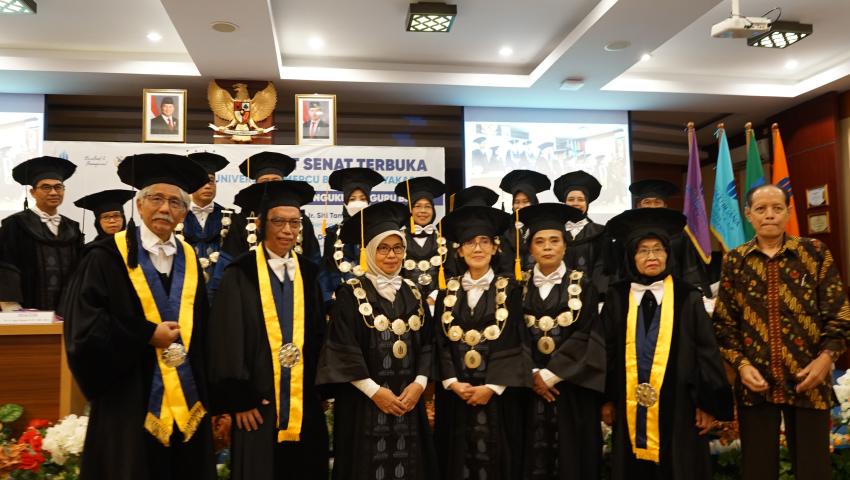
Yogyakarta, September 17, 2025, Mercu Buana University Yogyakarta (UMBY) officially inaugurated three new professors in the fields of food science, agriculture, and organizational management.
The event took place in the Rectorate Seminar Room at UMBY Campus 1 on Tuesday (September 16, 2025) and was attended by the academic community, leadership, and invited guests from various universities and partner institutions.
The three professors appointed were Prof. Dr. Chatarina Lilis Suryani, S.TP., M.P. (Food Biochemistry), Prof. Dr. Ir. Siti Tamaroh Cahyono Murti, M.P. (Food Chemistry and Technology), and Prof. Dr. Dorothea Wahyu Ariani, S.E., M.T. (Human Resource Management).
Each delivered a scientific speech on topics related to their fields of expertise, highlighting strategic issues ranging from natural foods and carbohydrate diversification to leadership in organizations.
In her speech, Prof. Chatarina Lilis Suryani emphasized that chlorophyll has great potential as a safe alternative natural green coloring agent in the food industry.
“Food color is a key attribute that consumers consider before purchasing. Color not only affects taste perception, but also serves as an indicator of food quality and safety,” she said.
She noted that although synthetic dyes are cheaper and more stable, various studies have shown their negative impact on health, including the risk of hyperactivity in children and potential DNA damage.
“Consumer awareness of the dangers of chemicals has led to higher demand for natural dyes,” said Chatarina.
According to her, chlorophyll, which has been known to come from pandan and suji leaves, has the potential to be further developed into a modern food dye. However, a major challenge arises because this pigment is easily damaged by light, heat, and pH.
“The main challenge is how to prevent color intensity from decreasing during food processing and storage,” she said.
A number of studies have focused on stabilization technologies, including the formation of metal complexes such as Zn-chlorophyll, binding with proteins, and microencapsulation.
“These efforts not only preserve color, but also enhance the functional properties of chlorophyll,” she said.
Meanwhile, Prof. Siti Tamaroh highlighted the importance of reducing dependence on rice as the main source of carbohydrates nationally.
According to data from the Central Statistics Agency (BPS), national rice production will reach 30.62 million tons in 2025, while the use of tubers is still limited.
"Purple uwi contains enough carbohydrates to meet daily energy needs. Additionally, the anthocyanin pigment functions as an antioxidant with potential anti-diabetic and anti-cholesterol properties. With these characteristics, purple uwi can be categorized as functional food," she said.
She explained that the anthocyanin content of purple uwi reaches 31–38 milligrams per 100 grams of dry matter, higher than several other commodities.
“Apart from being a source of energy, anthocyanin is also used in the food industry as a natural coloring and preservative, as well as in the cosmetics industry as an anti-aging ingredient,” said Siti Tamaroh.
Processing purple uwi into flour, she continued, will increase its added value and expand its uses.
With a carbohydrate content of more than 80 percent, purple uwi flour has the potential to become a healthy modern food ingredient.
In terms of cultivation, this plant is easy to grow in various types of land, including dry land, with a yield of 3–5 kilograms per plant.
"Its agronomic potential is high, but its utilization is still limited. In fact, uwi is an important commodity that ranks fourth in the tuber group after potatoes, cassava, and sweet potatoes," she said.
She emphasized that food diversification through local tubers such as purple uwi is an important solution for Indonesia's food security.
"With its functional properties, purple uwi not only meets energy needs but also supports public health. This is a great opportunity to support sustainable food security," said Siti Tamaroh.
Meanwhile, Prof. Dorothea Wahyu Ariani raised the role of leadership in maintaining and shaping organizational culture.
She likened the relationship between the two to two sides of a coin that influence each other.
"Leaders are goalkeepers who maintain the organizational culture that the founders envisioned. However, they must also be able to adapt to change so that the organization remains relevant," she said.
Dorothea emphasized that organizational culture is built on the basic values inherited from the founders. However, the entry of new individuals with diverse backgrounds can shift the direction of the organization.
“This is where the role of leaders comes in to reposition the direction of the organization so that it remains in line with its objectives,” said Dorothea.
She added that human resource management strategies—from recruitment, placement, training, to promotion—must be directed so that individual values are in line with the organizational culture.
“Similar values will increase the support felt by employees and strengthen their affective commitment to the organization,” she said.

Admin Web
Leave a comment
Your email address will not be published. Required fields are marked *